How to Read a Visual Field Study
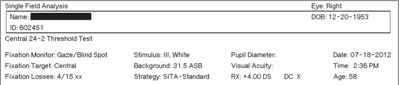 |
| i. The pinnacle of the VF printout page contains key information virtually patient demographics and the type of examination that was performed. Always review this portion for accuracy. On the Humphrey Field Analyzer (shown here), the best threshold test is the SITA-Standard. The standard exam is amend for early on detection, while the SITA-Fast test tends to testify variable results and is less sensitive.one The fixation losses are besides noted hither. |
Visual field testing is an important diagnostic consideration in the evaluation of patients with many different types of pathologies. Nigh ordinarily, it is used for atmospheric condition affecting the optic nerve and other forms of neurological affliction; but information technology's also helpful for retinal conditions and instances when visual field role needs to exist measured.
Automated, computerized and threshold static perimetry became bachelor about xxx years ago. While some of the basic principles of interpretation remain, advances in software and hardware take shortened test-taking time and improved accuracy and reliability. Given the subjective nature of the test, it'south essential to differentiate truthful, affliction-related defects and abnormalities from artifact and noise.
Evaluating visual field results from any perimeter can be confusing and daunting at times, especially when attempting to cohesively link all the information together. Good interpretation skills start with a methodical cess of several key plots, graphs and indices. By post-obit a standardized procedure on all visual field printouts, clinicians can ensure they are accurately diagnosing ocular disease and/or detecting progression.
For individuals, such as glaucoma patients, who have had a series of visual fields, new analyses are available that greatly help our ability to detect a alter in VF defects. In add-on, we can mensurate the rate of disease change too, giving us powerful insight to our management.
 |
| 2. Confirming the validity of the VF is the 2d step. Fixation losses, false positives and false negatives are recorded—with simulated positives often being the nigh disquisitional. An error rate of 5% to 10% significantly affects the appearance, making the gray scale and other plots announced improve than they actually are.ane Do non follow old published guidelines of upward to a 33% credence rate.1 |
Beginning at the Height
While the printouts from different perimeters do not look identical, much of the displayed content and information is the same. Regardless of the instrument used, first at the top by locating data almost the test parameters (figure i) and reliability indices.
• Test parameters. Make sure the patient'southward birthdate is accurate, considering the examination results are compared to a normative database. Identify that the proper trial lens was calculated and utilized. Although a standard exam program and blueprint (e.thousand., 24-2, Threshold) is often selected for the majority of patients, be certain to ostend that the correct exam was selected.
• Reliability indices. Examining the reliability indices is the next key step in visual field estimation (figure two). Loftier fixation losses (more than 15% to xx%) are a strong indication that the test results are likely inaccurate. I fashion to reduce fixation losses is to make sure your technician properly aligns the patient and monitors their attending during the exam.
False positives, another key alphabetize, help to place a "trigger happy" patient who is pushing the response button even when no calorie-free stimuli are presented. The field may often expect normal or "cleaner" (with fewer defects depicted) on patients with values of 5% to x% or higher.
False negatives are identified when the patient does not respond to a lite stimulus that should take been detected, based upon earlier responses. Values of ten% to 15% or more are indicative of a patient who is not paying good attention during the grade of the test; the results may wait worse than they really are.
After reviewing these fundamental data points, the next part of the page tin can exist evaluated.
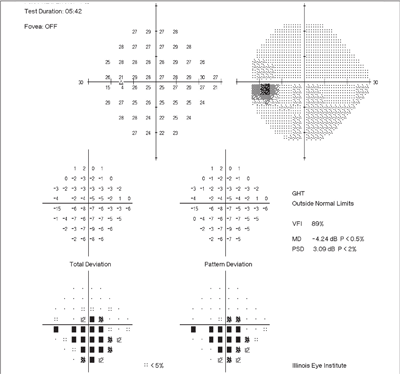 3. In this classic instance, the patient has moderate to advanced stage glaucoma. The large inferior defect is clearly depicted and appears similar on both the total and blueprint divergence plots. Of note, the grayness scale does not bear witness the defect, which is due to an interpolation error in the scaling. Remember, do not rely solely on the gray scale when evaluating visual fields. | 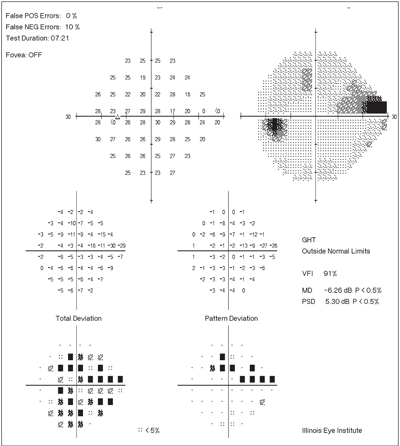 |
| | four. This patient has a mild cataract and glaucoma. The generalized depression from the cataract is evident on the TD plot (lower left). The localized defect—a superior nasal footstep with an arcuate component—caused by the glaucoma is seen on the PD plot. Additional key indicators—the global indices—are on right side of the folio. The glaucoma hemifield test (GHT) is a sensitive indicator of differences between the superior and junior hemifields. The VFI is an overall mark of field loss like to the MD. Patients with values below seventy% may brainstorm to notice functional defects. |
Don't Go Lost in the Middle
The center function of whatsoever visual field printout page tin can exist confusing, with its multiple graphs and plots. There are plots that display the "raw data" in decibels (dB) from the patient's test. While the dB values can be helpful when there is alien data on the printout, they frequently don't need to be examined in item.
• Gray scale. The gray scale of the VF printout is an easy plot to use for quick identification of potential scotomas and depressions, equally well as getting a full general cess near the location and size of any defect. One common mistake in VF interpretation is that the clinician looks just at the grey scale (figure 3). Doing this can lead to inaccurate identification of VF loss. Rather, the gray scale should be viewed as a starting point, as two other plots—total deviation (TD) and the blueprint difference (PD)—must be assessed to go the full and accurate clinical motion-picture show.
• Total deviation . The TD plot shows all the portions of the patient's visual field that are unlike from a "normal" patient'southward field of the same age. Information technology is a key graph that can be best assessed past using the probability plots with the shaded boxes at each test location, and not the numerical dB plot.
Solid, fully black squares indicate test points that are statistically more likely to be abnormal compared to the other, lighter shades of grey. When examining the TD plot, look at the size, shape and location of any abnormal points/boxes. Often, a generalized depression (perhaps from a cataract) is noted on this plot, with darkly shaded squares uniformly filling up the filigree (figure 4). However, when trying to identify a visual field defect related to glaucoma or lesions along the visual pathway, localized defects (not generalized) are the primal finding. Localized defects will appear on the TD plot, but may be hidden by a generalized depression acquired past a corneal or lenticular opacity. To separate the localized defect (likely the truthful disease-related defect) from any defect caused by a media opacity, the PD plot must be examined.
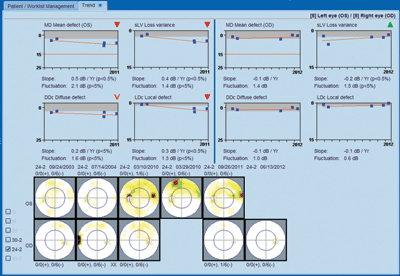 |
| 5. This is a progression analysis printout (EyeSuite, Haag-Streit) for a patient with advancing glaucoma in the left eye. EyeSuite uses the mean defect (same as mean divergence) value, amid others, to plot the charge per unit of change. In this example with visual field tests from 2003 to 2011, there is a negative slope to the MD. Red triangles generated by the software alert the clinician. |
• Pattern divergence. As with the TD plot, the PD plot is best analyzed by using the shaded boxes on the probability plot. The PD plot is designed to highlight localized defects by "removing" generalized visual field loss (likely due to a cataract). Truthful defects on the PD should exist characterized by their shape and location (i.eastward., nasal steps, central and arcuate scotomas). Clusters of side by side points can be grouped together so that their particular shape can be associated with the correlating disease or lesion.
The Final Footstep
The key indicators that remain are often establish on the right side of the printed page. Thus, the middle role of the printout should exist read from left to right, proceeding from total to PD plots and then to the global indices. The global indices give a numerical quantification in decibels of the visual field loss that appears on the page.
The mean divergence or hateful defect (Md) gives an overall value of the total amount of visual field loss, with normal values typically within 0dB to -2dB. The MD value becomes more negative equally the overall field worsens—a common example is when a cataract progresses.
Using MD for tracking changes to localized field loss (as in glaucoma) is limited. For patients with a localized visual field defect, the pattern standard divergence (PSD) best quantifies the amount of loss likewise whatever progression of glaucoma in the early stages. Note that the PSD is not helpful in tracking advanced glaucomatous defects. Despite its limitations, the Dr. value can exist helpful in tracking moderate stage glaucomatous visual field loss (-6dB to 12dB), because at this betoken the corporeality of localized loss is significant enough to be tracked.
On the Humphrey Field Analyzer, the visual field index (VFI)—a value similar to the Md—was added to the printout several years agone. The VFI is a staging index for the total corporeality of field loss. Information technology is reported to exist less sensitive to cataracts.ane Values range from 100% (normal) to 0% (perimetrically blind). The percentage value tin be tracked over a series of tests and used as 1 indicator for progression.
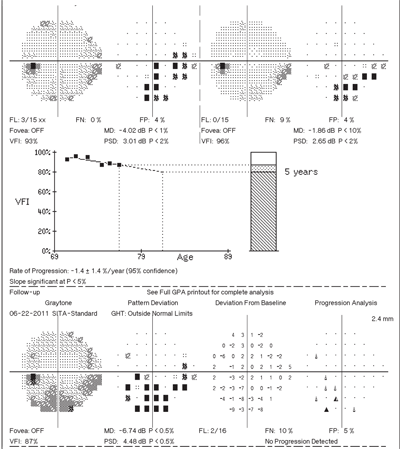 |
| half-dozen. This is a progression analysis printout (Guided Progression Analysis, or GPA, Humphrey Field Analyzer) for a patient with advancing glaucoma in the left eye. The two baseline fields are on the top while the about recent test is on the bottom. In the middle is a tendency line analysis, which is a regression line of the VFI values for the series of tests. The slope of this line is plotted as a charge per unit of change indicator. While many variables must be considered, values of -one.v% or more should be considered high, and more ambitious therapy may be indicated.1 |
New Information Analysis for Chronic Illness
Authentic progression assay of VF changes is essential to monitor patients with optic nervus disease, peculiarly glaucoma. In the by, the trend or change analysis provided on the printout was very limited. Clinicians resorted to looking back over multiple VF pages scattered within the patient'southward chart. They could as well try to rail the MD or PSD to see if individual values got worse or stayed the aforementioned. Practically speaking, this was a tedious and fourth dimension-consuming task. Instead, some doctors simply looked just at the gray calibration to run across if the defect got larger or darker—only doing so could lead to major errors in VF interpretation.
New perimeters comprise a much more than authentic tracking organisation for decibel values. Using the most recent software packages, they are able to brandish trend lines that tin quantify the charge per unit of alter to the visual field defect (effigy 5). These trend lines are a statistical regression line analysis of the MD value or a similar value that reflects the overall field sensitivity. New perimeters can produce graphs with a regression line based upon a series of visual fields over a fourth dimension menses.
A line with a negative gradient indicates worsening of the VF defect. The gradient of this line can be calculated by the perimeter and provide the charge per unit of loss. Identifying the rate of change (loss) in a glaucoma patient is a new slice of data that allows differentiation of "tedious" progressors that have a shallow, sloped tendency line equally compared to "rapid" progressors with a very footstep slope trend line.
Some progression assay plots tin can also provide a five-year projection of VF loss, assuming no modify in treatment or underlying illness. An example of this is seen in the Humphrey Field Analyzer GPA printout that uses the VFI (effigy 6).
These progression plots accept had the largest impact on patient management for chronic disease, significantly improving any clinician's ability to identify change. With a little experience, they are easily read and understood. Unfortunately, their use is not widespread, either from lack of awareness or from doctors and clinics using outdated software. Practitioners should evaluate their current perimeter and investigate options for upgrading hardware and or software and so that they tin can use the newest tools.
Dr. Chaglasian is an associate professor at Illinois College of Optometry and chief of staff of the Illinois Eye Institute, in Chicago.
1. Heijl A, Patella VM, Bengtsson B. The Field Analyzer Primer: Effective Perimetry. 4th ed. Dublin, CA: Carl Zeiss Meditec; 2012.
Source: https://www.reviewofoptometry.com/article/sharpen-your-visual-field-interpretation-skills
0 Response to "How to Read a Visual Field Study"
Post a Comment